Author: maitlas12

  • Depression: Causes, Symptoms and Treatment!

    Depression: Causes, Symptoms and Treatment!

    What is depression?

    Depression and depressive disorders in general interfere with everyday functioning human being. They cause pain and suffering not only to those who suffer, but also their loved ones. A severe depression can destroy both the life of the person suffering as his family.

    Most depressed people do not seek treatment or help. Although the vast majority (including severe depression sufferers) could receive help and healing. We believe that spiritual guidance in your church, family support, the help of professional experts in the subject, prayer and Bible reading are essential for a speedy recovery, as well as personal motivation, controlling emotions and physical exercise are of vital help to a significant immediate relief of symptoms.

    What is a depressive disorder?

    Depressive disorder is an illness that affects the body (mainly brain), mood, and thinking. It affects the way a person eats and sleeps. It affects how one values himself (self-esteem) and how you think. A depressive disorder is not the same as a passing blue mood. No sign of personal weakness. It is a condition in which a person can be released without advice will, for lack of information, support and tools to fight him.

    People with a depressive illness cannot simply say “enough is enough, I’m going to be fine”, but there is a real basis of knowledge, faith, self-esteem and willingness on the part of him. Without professional advice, symptoms can last for weeks, months and even years, immersing a person in a chaotic world, so many resort to violent solutions, drug abuse, alcohol, drugs and some to the point of taking your own life.

    Types of depression

    As in other diseases, there are several types of disorders related to depression.

    The three most common types are: major depression, dysthymia and bipolar disorder. In each of these three types, the number, severity and persistence of symptoms vary.

    Major depression is manifested by a combination of symptoms that interfere with the ability to work, sleep, eat, and enjoy once pleasurable activities. A very disabling episode of depression may occur only once in a lifetime, but it usually occurs several times in the course of life.

    Dysthymia, a less severe type of depression, symptoms include chronic (long term) not disabling both, but nevertheless interfere with the functioning and well-being of the person. Many people with dysthymia also experience major depressive episodes at some time in their life.

    Another type of bipolar disorder is also called manic-depressive illness. This is not as common as other depressive disorders. Bipolar disorder is characterized by cyclic changes in mood: mood phases severe highs (mania) and low mood (depression). The mood changes can be dramatic and rapid, but most often they are gradual. When a person is in the depressed cycle, may suffer from one, some or all of the symptoms of major depressive disorder.

    When in the manic phase, the individual may be overactive, too and have a lot of energy. Mania often affects thinking, judgment and how to behave in relation to others. You can bring the patient to get into serious problems and embarrassment.

    For example, in the manic phase the person may feel happy or elated, having grandiose projects, outlandish business decisions, and engage in adventures or romantic fantasies. If left untreated mania may worsen to a psychotic state (the patient temporarily loses reason).

    Causes of Depression

    Some types of depression tend to affect members of the same family, so that many suggest that you can inherit a biological predisposition. Apparently, there are additional factors that contribute to the disease is triggered: possibly stresses in life, family problems, work or study. In some families, major depression occurs generation after generation. However, severe depression can also affect people who have a family history of depression.

    Whether inherited or not, major depressive disorder is often associated with changes in brain structure or function as medicine. It is believed that the environment in which the person develops, education, goals, achievements and influence perception of life greatly. People with low self-esteem perceive themselves and perceive the world with pessimism. People with low self-esteem and are easily overwhelmed by stress are predisposed to depression. It is unclear whether this represents a psychological predisposition or an early stage of the disease.

    Where did it come from?

    Depression is a “normal” reaction of the human being as it is a reaction to certain emotional factors that distort judgment, self-esteem and mood of the individual. Our person needs a spiritual and physical balance to stay healthy. It is very difficult and very unlikely for a person to maintain a healthy body and mind in your life when there are only conflicts, resentment, hatred, low self esteem, negative memories, guilt, remorse, and especially if there is no peace at home and in his person. The word peace, goes beyond human perception, is a gift from God.

    Illness, especially psychological are a manifestation of the inner state of the person, excessive stress, guilt, hatred, addictions, resentment, low self esteem, bad thoughts and all this burden we carry through our existence is in many cases the Body reason for our situation, this is nothing new and you can tell any professional who deals with emotional conflict situations personas. These becomes heavier as time passes and it is believed that there comes a time when our inner person collapses and not tolerate his load and this is manifested in physical form (Heart disease, diabetes, high blood pressure, ulcers, chronic pain, depression, anxiety, phobias, hobbies etc).

    Another common cause psychological disorders is trauma, either something they impact children or affects them today for example, sexual abuse, verbal, physical, death of a loved one or friend etc.., These factors may reach generate a self-destructive behavior and violent people and is very important to treat these factors together with the depressive condition given that these greatly affect the individual’s emotional development especially in regard to self-esteem and how they see the world.

    Symptoms of Depression

    Not all people who are depressed or manic phases or all suffer from the same symptoms. Some suffer from a few symptoms, others have many. The severity of symptoms varies from person to person and can change over time.

    We must also emphasize that the fact that a person has any of these symptoms sporadically, does not necessarily make a person depressed, because many of these symptoms can be caused by many external factors or other special situations such as illness or drugs.

    The most common symptoms to recognize signs of depression are:

    1. Restlessness, sad mood, anxious or “empty” persistently.

    2. Feelings of guilt, worthlessness and helplessness.

    3. Loss of interest in activities once enjoyed, including sex.

    4. Difficulty concentrating, remembering, and making decisions.

    5. Decreased energy, fatigue, exhaustion.

    6. Weight loss, appetite, or both, or overeating and gaining weight account.

    7. Insomnia, sleep disorders and their schedules.

    8. Thoughts of death or suicide, suicide attempts.

    9. Chronic physical symptoms: headaches, digestive disorders and other frequent pains.

    10. Mania, abnormal or excessive euphoria.

    11. Poor judgment.

    12. Irritability.

    Some tips you can follow while you recover from your condition are:

    * Seek professional biblical counseling, read the Bible and do daily prayer, this strengthens not only the spirit, also strengthens the mind and helps to relieve emotional burdens.

    * Set realistic goals along your recovery and Fe fijate goals throughout your life.

    * Achieve your goals, set priorities, and do what is in their power to do and have faith.

    * Try to be with and to talk to someone you trust.

    * Take part in activities that help you feel better.

    * Work light, go to the movies, go to a sports game, or participating in recreational, religious, social or otherwise. All this can help.

    * Expect your mood to improve immediately, but gradually. Feeling better takes time.

    * It is advisable to postpone important decisions or projects until their condition improves. Before making major changes in your life and in your family who deserve a serious observation and radical changes, consult with trusted people who know you well and can help you have a more objective view of your situation.

    * People rarely leaves a depression overnight. But you may feel a little better every day if they want you.

    * Remember!, Positive patterns of thought will eventually replace negative thoughts that are part of the depression. Negative patterns will disappear as soon as your depression responds to treatment and counseling.

    * Let family and friends help, and not be ashamed of your situation, get over it!

    * Smile today, tomorrow and always, as there is a God and there is always a solution to every problem.

  • Mental Health: Keeping Your Emotional Health

    Mental Health: Keeping Your Emotional Health

    What is good emotional health?

    People who are emotionally healthy are in control of their thoughts, feelings and behaviors. They feel good about themselves and have good relationships. They can keep problems in perspective.

    It is important to remember that people who have good emotional health sometimes have emotional problems or mental illness. Mental illness often has a physical cause, such as a chemical imbalance in the brain. Stress and problems with family, work or school can sometimes trigger mental illness or make it worse. However, people who are emotionally healthy have learned ways to cope with stress and problems. They know when they need to seek help from your doctor or a counselor.

    What about the anger?

    People sometimes do not know the cause of your anger, how much anger they are holding inside or how to express anger. You may be angry about certain events, self, or in connection with the actions of other people. In addition, many little things can build up and make you feel that life is unfair.

    If you realize that you are getting too irritable or taking unhealthy risks (like drinking too much or abusing drugs), you may have a problem dealing with anger. It is very important that you speak with a doctor or a counselor about getting help.

    What I can do to avoid problems?

    First, be aware of your emotions and reactions and try to understand them. Learn to differentiate the causes of sadness, frustration and anger in your life can help you better manage your emotional health. The picture on the right gives you some other useful tips.Tips for Dealing with your emotions Learn to express your feelings in appropriate ways. It is important that people who are close to you know when something is bothering you. Keeping feelings of sadness or anger inside takes extra energy and can cause problems in your relationships and at work or school.

    Think before you act. Emotions can be very strong. But before you get carried away by their emotions and say or do something you might regret, take time to think things through.

    Strive for a balanced life. Make time for things you enjoy. Focus on the positive things in your life.

    Take care of your physical health. Your physical health can affect your emotional health. Take care of your body by exercising regularly, eating healthy foods and getting enough sleep. Do not abuse drugs or alcohol.

    How does stress affect my emotions?

    Your body responds to stress by producing stress hormones. These hormones help your body respond to situations of extreme need. But when your body produces too many of these hormones for a long time, the hormones wear down your body and emotions. People who are under the effects of stress (stressed) are often emotional, anxious, irritable and even depressed.

    If possible, try to change the situation that is causing stress. Relaxation methods such as deep breathing and meditation, and exercise are also helpful for coping with stress.

    Can emotional problems be treated?

    Yes psychological counseling, support groups and medications can help people with emotional or mental illness. If you have an emotional problem, talk with your family doctor. The doctor can help you find the right type of treatment.

  • Stress: how to cope better with the challenges of life

    Stress: how to cope better with the challenges of life

    What causes stress?

    Feelings of stress are caused by instinct that the body has to defend itself. This instinct is good in emergencies, such as getting out of the way of a speeding car. But stress can cause physical symptoms if it continues for a long time, for example, in response to the challenges of everyday life and change.

    In this situation, it is as if your body gets ready to jump the car but you still here. Your body is working more than necessary with no place to put all that extra energy. This can make you feel anxious, afraid, worried and uptight.

    What changes may be stressful?

    Any kind of change can make you feel stressed, even good change. It’s not just the change or event itself, but also how you react to it that matters. What is stressful is different for each person. For example, a person may feel stressed by retiring, unlike others.

    Among other stressful situations are a job layoff when your child leaves the house and returns to it, the death of a spouse, divorce or marriage, an illness, an injury, a promotion at work, money problems, moving, or the birth of a child.

    Can stress hurt my health?

    Yes and it may even make them worse. Talk to your family doctor if you think some of your symptoms are caused by stress. It is important to make sure your symptoms are not caused by other health problems.Possible signs of stress

    • Anxiety
    • Backache
    • Constipation or diarrhea
    • Depression
    • Fatigue
    • Headaches
    • Blood pressure (blood) elevated
    • Trouble sleeping or insomnia
    • Problems in relationships with others
    • Feeling of “shortness of breath”
    • Stiff neck or jaw
    • Upset stomach
    • Weight gain or loss

    What I can do to reduce my stress?

    The first step is learning to recognize when you’re feeling stressed. The first signs of stress include tense shoulders and neck, or clenching your hands into fists.

    The next step is to choose a method for managing stress. One way is to avoid the event or thing that leads to stress, but often this is not possible. A second alternative is to change the way you react to stress. Usually, this is the best option.

    Tips to handle stress

    Do not worry about the things you cannot control, such as weather.
    Solve the little problems. In this way, you can acquire a sense of control.
    Prepare as best you can for events you know may be stressful, like a job interview.
    Try to look at change as a positive challenge, not a threat.
    Try to resolve conflicts with other people.
    Talk to a friend in whom you trust, with a relative or a counselor.
    Set realistic goals at home and at work. Avoid excessive plans.
    Exercise regularly.
    Eat well-balanced meals regularly and get enough sleep.
    Meditate.
    Participate in something you do not find stressful, such as sports, social events or hobbies.

    Why is exercise useful?

    Exercise is a good way to deal with stress, it is a healthy way to relieve pent-up energy and tension. We are aware that exercise releases chemicals in the brain that make you feel good. In addition, it helps you get in better shape, which makes you feel better overall.

    What is meditation?

    Meditation is a form of guided thought. It can take many forms. You can implement it with exercise repeating the same movements over and over, like walking or swimming. You can meditate by practicing relaxation techniques, exercising, stretching or breathing deeply.

    Training to relax is easy. Start with one muscle. Hold tight for a few seconds then relax. Repeat this step for each of the muscles starting with the toes, followed by the feet and moving up through the parts of the body, one muscle group at a time.

    Stretching can also relieve stress. Turn your head in a gentle circle. Raise your arms trying to reach the ceiling and bend side to side slowly. Roll your shoulders.

    Deep, relaxed breathing itself can help relieve stress (see table at right). In this way, you can get enough oxygen and activate the relaxation response, the antidote of the body to stress.

    If you want more help for the treatment of stress symptoms, seek advice from your family doctor.

  • How EMDR Training Can Help Psychiatric Professionals To Combat The Symptoms Of Post Traumatic Stress Disorder

    How EMDR Training Can Help Psychiatric Professionals To Combat The Symptoms Of Post Traumatic Stress Disorder

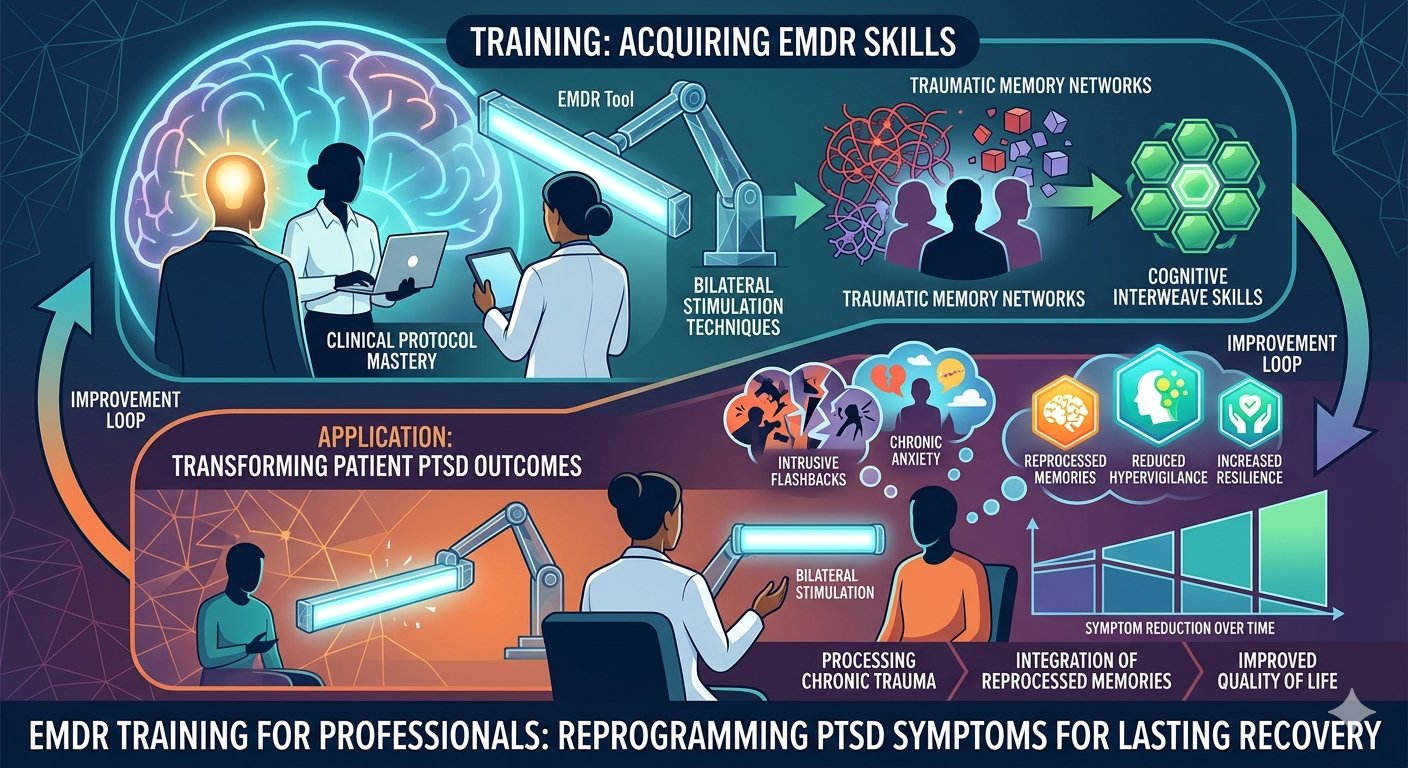
    Individuals who have been subjected to significantly traumatic events, such as sexual or physical assault, military combat experiences, major accidents or even the sudden death of a loved one, can, if certain symptoms present themselves, be diagnosed with post-traumatic stress disorder (PTSD). These symptoms include distressing thoughts of the event; nightmares and/or flashbacks; insomnia; anger issues, and avoiding anything which is seen as being a reminder of the event. If you are going through a stress disorder, online doctor service can be helpful to get immediate releaf in this condition.

    Understanding PTSD

    It is thought that PTSD occurs when an experience is so disturbing to an individual that it disrupts the information processing system within their brain. One of the main functions of this system is to process disturbing experiences by way of mental adaptation. This basically translates as, whenever something unpleasant or disturbing happens to a person, the processing system ‘digests’ the experience and processes it in the most effective way. This generally means that the appropriate connections are made, while reactions which are deemed unnecessary — such as negative self-talk, harmful emotions and physical sensations — are discarded.

    If an experience is too disturbing however, the system can become disrupted and cause the memories associated with it to become stored along with some – or all – of the negative emotions, physical sensations and harmful beliefs. This presents itself as a problem as people’s brains are conditioned to use these stored memory ‘links’ to help interpret and process ways to deal with current experiences. Needless to say, having an unprocessed memory ‘shorting the circuit’ can cause negative emotions and sensations to emerge and affect an individual’s perception of current events without warning. In short, this what makes it difficult for people with PTSD to leave their distressing memories behind. To them, the past and the present are often one and the same.

    Eye Movement Desensitisation and Reprocessing (EMDR)

    Increasing numbers of psychiatric professionals are now opting to send themselves on EMDR training courses as they believe this particular form of treatment is the best way to help patients suffering with symptoms of PTSD. The basic premise of EMDR is that the intensity of feelings associated with a particularly traumatic memory can be reduced – or sometimes even eliminated – by using specific eye movements. When carried out by a therapist who has undertaken a suitable EMDR training course, this form of treatment can adjust and/or restore the way a patient’s brain functions, thereby enabling them to eventually address and override their mental trauma issues. It is often the case that patients who undertake successful EMDR treatment end up being able to recall their memories without experiencing the same degree of psychological distress they did before the treatment began.

    EMDR therapy has been declared an effective form of trauma treatment by everyone from the American Psychiatric Association to the International Society for Traumatic Stress Studies so it is fair to say getting on an EMDR course is an unequivocal step in the right direction for any conscientious psychiatric professional.

    About the author – Bo Heamyan blogs regularly about twenty-first century health concerns and has written extensively about the merits of EMDR therapy for various industry leading websites, including EMDRworks.org

  • Do You Have Difficulty Making Decisions?

    Do You Have Difficulty Making Decisions?

    Do you have difficulty making decisions? If you are going through a lot of inner conflict, having trouble making decisions, or find yourself overwhelmed with things that used to be no problem for you, it might be a good time to come in and talk things through with a qualified therapist. Our therapists are nonjudgmental, supportive, and have tools to help resolve inner conflict.

    This article is written by Alicia Shamblin LMSW, working as psychotherapist at Apex Behavioral Health Dearborn.

  • What Do You Say When You Talk To Yourself?

    What Do You Say When You Talk To Yourself?

    Most of us have an inner dialogue that is running all the time. Unless you meditate (and even then it can be very difficult), most people can’t get away from themselves. Because your inner dialogue is with you all the time, you may even confuse it for who you are or believe it what you tell yourself is always right.

    You are not your thoughts. If you try to observe your thoughts, you are actually the witness of your thoughts. This can be a very helpful practice. The inner dialogue can be wrong and we need to pay attention so that we don’t accept every message it gives us. Just consider how many times you have told yourself something and then realized you were wrong.

    Paying attention to your thoughts and being able to redirect them or change them is a very important part of mental health. Doing this can be part of the problem or part of the solution, depending on the messages you feed yourself.

    As an example, someone’s inner dialogue might go like this: “I need to pick up milk at the store. You idiot! You should have gotten it yesterday while you were at the store. I can’t believe that car just pulled right out in front of me. What a jerk! Can’t you see me? I’m right here! Who is that calling me right now? I can’t get a break! Why can’t people just leave me alone for five minutes! No one would be able to get along without me. I have to do everything for everyone in my family. They don’t even appreciate me. Why should they? I’m not really good enough. I yell at everyone. They seem stressed just having me around….”

    How much attention do you pay to your inner voice? Does it sound like that or are you kinder to yourself (and others)? The same scenario could sound differently if your inner dialogue was like this:

    “I think I’ll stop and get some milk on my way home. Woa! Good thing I was watching out. I hope that other driver gets where they’re going alright. They must be in a hurry. Hmm, I hear my phone but I’m driving right now. I will check it after I park my car. I’m glad to be driving home and spending time with my family. I’m so lucky to have them!”

    Why is the person in the first dialogue so much more stressed than the person in the second dialogue? Maybe they have all the same stresses in their lives but it’s the way they talk to themselves that makes the difference. Can you pick out some of the differences between the underlying beliefs in the two examples?

    Stop and listen to what you say to yourself. Is it critical, judgmental and mean? “Why can’t I do anything right? What is wrong with me? I’m such a loser. No wonder no one seems to care about me. Why should anyone care? Remember that major screw up you made last week?”

    People are often rough with themselves thinking it will help with self-improvement. “I can’t be nice to myself. If I did, I would let myself get away with all kinds of things. By talking to myself this way, I can make sure I shape up.” Actually, the opposite is true. Beating yourself up in your mind all the time takes away your confidence, your motivation and the good feelings you might have otherwise had. Imagine if you talked to your friends like that. Would you even have friends? Stop and listen to yourself and try to correct the messages you give yourself to be more like something you would want to say to a friend, something like, “You’ll do better next time.”

    Isn’t that more motivating? Besides, it is much less likely to coincide with depression, anxiety and low self-confidence. Try paying attention to your inner dialogue and adjust the messages you give yourself. It might help to write your thoughts or type them. That way you can really take time to look at the messages and find ways to adjust them to more positive, accepting, optimistic, motivating messages.

    This article is written by Alicia Shamblin LMSW, working as psychotherapist at Apex Behavioral Health Dearborn.

  • Emotions Are Contagious. Take Care of Your Mental Hygiene.

    Emotions Are Contagious. Take Care of Your Mental Hygiene.

    It is practically universal that if someone flashes you a genuine smile, you feel good and are likely to smile back. Remember the last time you started laughing just because other people were laughing? I’m so glad laughter is contagious!

    But what I noticed is that even though all emotions can be spread from one person to another, it can be easier to be sensitive to others’ pain than to be sensitive to their joy. It seems to take a lot more joy before it starts to rub off on those around you, and it takes very little negativity in comparison before your mood is contagious. If I’m in a good mood, I can be deflated much more quickly and easily compared to how hard it would be to cheer me up when I’m feeling really down.

    Of course, some of that depends on our genetic, or inherited, level of emotional resilience, and then we need to take into consideration our own personalities, environments, and the moods we are more habituated toward. (This last part is where therapeutic techniques and practice come into play!) Even when allowances are made for all those factors, it is often true that negative emotions are more contagious than the positive ones. One theory of why this happens is that it is a survival instinct that exists in many animals, not just humans.

    If a family, tribe or community is in danger, the first person in the group to notice the threat, is likely to experience worry, fear or anger. If other members of a group are able to tune into the threat and work together to protect themselves, the entire community is likely to be more effective at surviving.

    Similarly, it helps to be able to recognize when someone in the group is angry and likely to become violent, giving off the vibe that “nobody better look at me the wrong way today!” If you notice that look on the person’s face and recognize the angry body language, this can be fairly effective at telling you to give that person space, thus helping promote survival.

    It isn’t always a good experience, and not always in our favor. Sometimes people respond to negative emotions by getting angry, especially if negative emotions become chronic and it seems like that person is always depressed or always angry. Maybe I don’t want to be around someone who is bringing down my mood, and I blame that person for how I feel when I’m around him or her. Unnecessary conflict often arises from this type of situation. Negative emotions can also become chronic and lead to stress-related diseases, so loving someone with major depression, for example, might put my own health at risk if I am unable to keep my own spirits lifted.

    Even complete strangers who are very different from ourselves can trigger feelings of extreme empathy that can be almost intolerable – seeing anyone express anger, tears, frustration, or any kind of discomfort is just not pleasant. If that’s true just by yourself, consider how much more difficult that can be when you live in a large family or community of people who pretty much all experience “negative” emotions on a daily basis, like if you work with a lot of negative people. Even if the entire group is happy, and only one person is having a lot of anger or depression, it can ruin it for the entire group! What are the odds that everyone is going to have a good day all at once? Living and working in communities of people doesn’t just spread colds and flu. It can also spread all kinds of emotions that are contagious.

    Some of us are so sensitive that we don’t even know why we are upset or not feeling well. What I have noticed, and I’m glad to see more people are becoming aware about this topic, is that some people are so empathic that they actually feel pain (physical or emotional) that doesn’t even belong to themselves. It isn’t “just” emotional, such as sadness, not feeling interest in life, feelings of dread and not knowing why, crying spells, panic attacks, irritability and anger outbursts. For many of us, these feelings also come with abdominal distress, headaches, back and neck pain, and all kinds of things that are difficult to know where it is coming from, such as dizziness, numbness or tingling in the extremities, low energy, or feeling faint and tired. We’ve learned over the years that chronic stress is a major contributor to many major physical illnesses, including cancer and heart disease.

    We’ve all heard of sympathy pains, and can understand that it does not feel good to see someone else suffer, especially someone we love. On occasion, someone will not even be consciously aware the other person was suffering because it was hidden, but relief is noticed when the other person goes away on vacation or is no longer around – sometimes because the other person was a pain, but sometimes just because the other person was in pain. Sometimes people can’t tell the difference.

    I’m not suggesting you blame others for your emotions, and loneliness and isolation are not what I’m advocating. I’m not telling you to quit your job or end relationships with people you care about. We are social creatures. Even introverts need social experiences to be happy. I don’t believe you are “too sensitive” or “overly emotional” if you have high levels of sensitivity and empathy, either. My point is, emotions are contagious and sometimes it might be helpful for us to notice and accept the fact that this is so.

    It helps to recognize that if I am feeling very upset or uncomfortable and don’t know why, I might be tuning into the feelings or experiences of others without realizing it. Once I realize what is happening, I can then figure out what to do about it. Awareness is an important step in feeling less “out of control” of my emotional experiences. Then I can take care of my own emotional hygiene, the equivalent of washing my hands after using the bathroom to stop the spread of illness.

    We all need to take care of our own emotional well being and monitor which thoughts and feelings we are harboring. Each moment we are aware, we can make conscious choices about letting go of negative thinking and negative emotions. Each moment we realize we have a choice, we can feed the positive aspects of our lives and build them stronger. As you become more adept of these skills, you can help prevent yourself from being that person who spreads negativity to your friends, coworkers and loved ones.